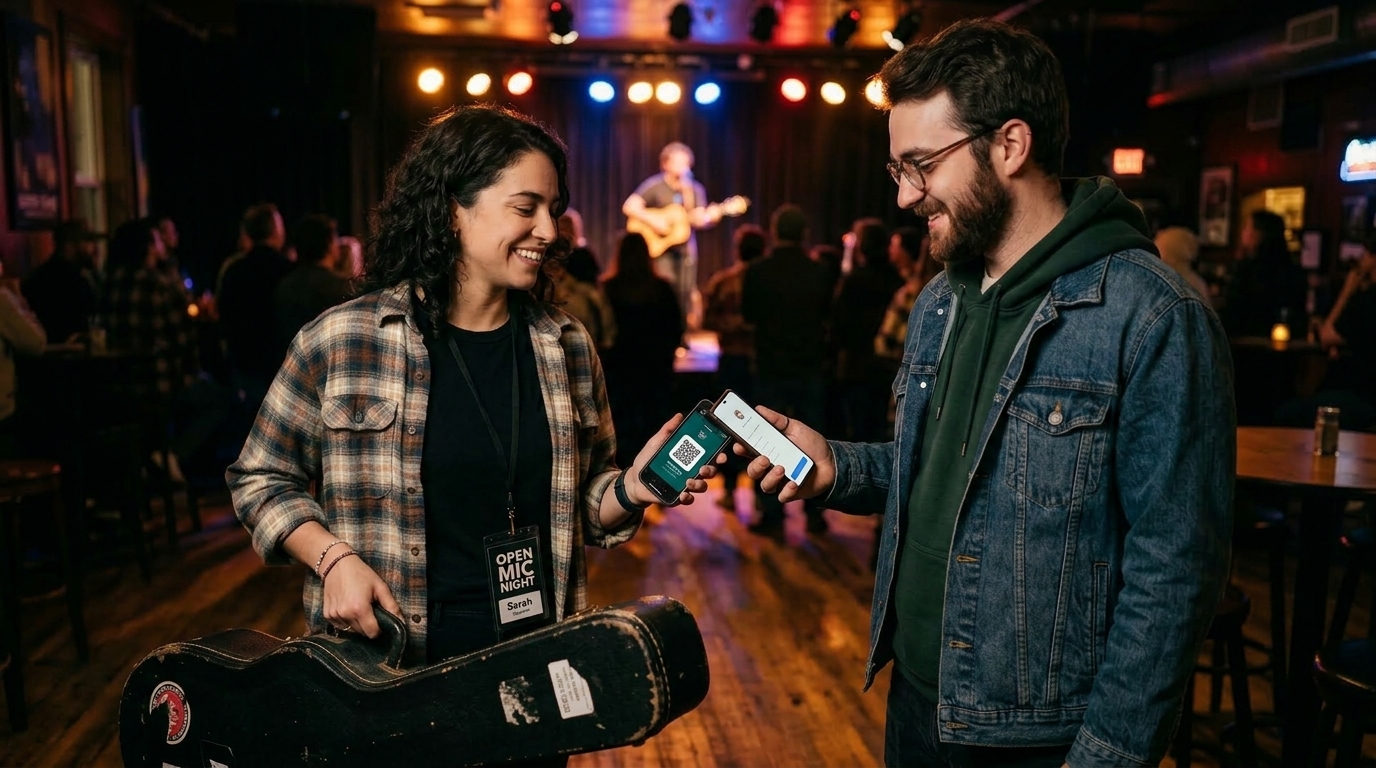
You don't need a million followers to earn affiliate commission. You need a room full of people who trust you.
Think about the people in your own life who are quietly, constantly asked for advice. The guitarist who hosts the Tuesday open mic and is cornered at every break with "what's that pedal?" The running-club organiser whose members all want to know which shoes survive a marathon. The barista who can talk for twenty minutes about grinders. The photographer who runs the monthly meetup where somebody always asks, "Which lens should I buy?"
These people influence thousands of euros, pounds and dollars of spending every year. Almost none of it earns them a penny. And the brands that would happily pay for those recommendations never find out they happened.
This article is for those people: the small-time affiliate who knows one specific community very well. We'll look at why that is a more valuable position than it sounds, where the opportunity quietly leaks away, and how a digital business card app like Wolleato can plug the leak, for the price of a few coffees a year.
Affiliate marketing has a size problem, and it isn't yours
When most people picture affiliate marketing, they picture large review websites, YouTube channels with huge audiences, and comparison portals that rank for every product under the sun. It's easy to conclude that the game belongs to whoever has the most traffic.
But traffic and trust are different currencies. A stranger reading a "Top 10 Audio Interfaces" article has no idea who wrote it, and has probably read three other lists that week. A musician who watches you play every Tuesday and hears you say "this is the mic I use, it's brilliant for the money" is in a completely different frame of mind. They're not browsing. They already trust you, and they are about to buy something.
Brands know this. It's the reason "ambassador", "community" and "micro-influencer" programmes have become such a fixture of marketing budgets. The affiliate channel is rich with small, local, niche voices that large companies can't easily reach themselves. The Thomanns and Gear4musics of the world have sophisticated programmes, but they can't be at your open mic. You can.
The commission is real, even if the numbers are modest
Let's stay realistic. Affiliate commission in most retail categories is a few percent, not a fortune. Musical instrument retailers such as Thomann and Gear4music both run public affiliate programmes, and at the time of writing their advertised rates are in the region of up to 4.5% and up to 5% respectively. Thomann's programme has also been described with a cookie window of around 14 days. Programme terms change, so always check the current conditions before you sign up.
A few percent of an £80 order is about £4. That doesn't sound like life-changing money, and on its own it isn't. But multiply it by the number of people you talk to, the number of times a year you talk to them, and the number of things each of them eventually buys, and you start to see why the small affiliate's position is stronger than it looks. A strings-and-cables order today. A microphone next month. A PA system when the venue finally upgrades. These are recurring purchases from people who keep coming back to ask you what to get next.
Where the opportunity quietly disappears
Here's the part nobody talks about: the conversation is where affiliate sales are won, and it's also where they're lost.
Imagine the scene. You're at the open mic. A young guitarist wanders over between acts and asks about your pedalboard. You tell them about the overdrive pedal you swear by, the tuner, and the power supply. They're clearly interested. "Can you send me the details?" they ask.
"Sure, I'll message you later."
And then one of several things happens. You forget, because the night gets busy. You remember, but you can't find their name among all the other contacts. You send a message, but you've pasted a raw shop link with no affiliate tracking. Or you do everything right, but a week passes, the enthusiasm cools, and they never click.
Worst of all, they might remember the pedal's name, search for it on their own, and buy it somewhere else entirely. The recommendation was yours. The sale, and the commission, belongs to whoever happened to be at the top of the search results.
This is what experienced marketers call intent decay. Interest in a product peaks at the moment of the conversation and falls away quickly afterwards. Every minute between "that sounds great" and "here's the link" costs you a little conversion.
The tracking window is shrinking, too
The timing problem is made worse by what's happening to online tracking. Browsers such as Safari and Firefox have spent years limiting how long cookies can follow people around the web. Industry reports now suggest that a significant share of affiliate programmes, in the region of nearly four in ten, use tracking windows of seven days or fewer.
For the small affiliate, this has an important consequence. The old model, publishing content and hoping that someone clicks now and buys sometime in the next month, is becoming less reliable. What works better is catching the person while they are interested, at the moment they are talking to you, and getting your link in front of them straight away.
That's an advantage of the in-person world. The trouble is that most tools weren't designed to take advantage of it.
Meet Sam, the open mic host
Let's follow a single example from start to finish. Sam runs a weekly open mic night at a pub. About thirty to fifty people turn up each week, and over a couple of years Sam has built up a loose community of a few hundred regulars: singer-songwriters, bedroom producers, drummers, the odd sound engineer.
Sam plays gigs, owns a modest but well-chosen collection of gear, and is, without ever intending to be, the local authority on what's worth buying. Every week people ask about the guitar tuner clipped to the headstock, which mic works best for acoustic sets, and what Sam would buy if the pub's PA finally gave up.
Sam signs up for the affiliate programmes of music retailers like Thomann or Gear4music. Instead of building a complex website or setting up an intermediate landing page, Sam simply creates dedicated cards in Wolleato that point directly to the retailer via Sam's affiliate tracking links. One card links directly to Thomann's guitar & pedal section, another directly to keyboards, and another to specific gear pages.
On open mic night, when someone asks about the pedalboard or a guitar setup, Sam doesn't say "I'll send you something later". Sam simply selects the relevant card in Wolleato and says, "Hold your phone near mine" or "scan this". In less than a second, Thomann's site opens on the person's phone with Sam's affiliate link already attached. No intermediate catching sites, no coding, and no lost sales. Everything is instant.
Sam didn't have to remember anything. They didn't have to write anything down. There was no awkward typing of email addresses, no "what's your number again?", and no link pasted into a chat that would be buried under a hundred other messages by morning.
Turning one-off chats into an audience
The gear list is only half of Sam's setup. A second card collects contact details through a short form: name and email address, with a clear note that it's for a monthly "Gear of the Month" newsletter. People who want the tips leave their details. Those who don't, don't.
This is where things get interesting for the long term. After a year, Sam has a few hundred permission-based contacts, people who know Sam and asked to hear more. Each month, Sam sends one short, honest email about one piece of gear, with affiliate links where relevant. No algorithm decides who sees it. No platform can change the rules and wipe out the reach overnight. It's a small audience, but it belongs to Sam, and because it consists of real people who know Sam in person, it behaves very differently from an anonymous list.
It isn't just musicians
The open mic is only one example. The same pattern repeats wherever somebody knows a community well, meets its members face to face, and is regularly asked for recommendations. Here are a few more.
The running-club organiser
Every Saturday morning, forty runners gather for a group run. After the cool-down, the questions start: "Are those shoes good for road?" "Which gel do you take during a half marathon?" "What watch are you wearing?" The organiser has opinions, and they're based on years of real mileage. A "Kit I Actually Use" card, with links to a running retailer's affiliate programme and a sports nutrition brand, turns each of those chats into something actionable on the spot.
The photography meetup host
Camera gear is a notoriously research-heavy purchase. Meetup attendees constantly ask about lenses, bags, tripods and memory cards. A host who has a card for "My Bag" and another for "Beginner Kit Under £500" doesn't just answer the question. They hand over a ready-made shortlist, with affiliate links to specialist camera shops, at the moment the question gets asked.
The yoga or fitness instructor
Students ask about mats, blocks, resistance bands and supplements after almost every class. Instructors who recommend things they genuinely use, and say so honestly, often have a very high level of trust with their students. A card for "What's in My Studio Bag" is a more natural way to share it than a hurried chat as people roll up their mats.
The coffee or craft-food enthusiast
A home-roasting meetup, a local baking class, a sourdough swap. Every hobby community has its equipment, ingredients and tools, and everybody wants the shortcut to what works. A host who can say "scan this, here's my setup" is already doing what the affiliate channel was designed for.
The freelance consultant or networker
At the other end of the spectrum is the professional who attends business events and genuinely uses certain software tools: an accounting package, a scheduling tool, a design app. Many software companies run generous recurring affiliate programmes. A consultant who can say "these are the tools I use to run my business" and share a card with the lot, rather than hunting for links later, makes the whole thing frictionless, and happens to be earning a referral reward along the way.
In every one of these examples, the pattern is the same: a trusted person, a defined community, a repeated question and a missed opportunity at the moment of conversation.
What you actually need from a tool
If you've followed so far, you can probably guess what the ideal tool for this job looks like. It needs to do a handful of things well:
- Be instant. A tap or a scan, and the page is on the other person's phone. No app to download, no account to create.
- Let you have more than one card. A gear list for guitarists is not the same as a "book me for a lesson" page, and neither should be buried in a single menu of links.
- Capture contacts easily. A simple form, with the person's consent, that collects an email address or phone number without fuss.
- Work when the signal doesn't. Pub cellars, festival fields and crowded exhibition halls are famously poor places for mobile data.
- Respect privacy. You are collecting personal details from people who trust you. They deserve to know where that data goes, and so do you.
- Cost less than it earns. If the tool eats the commission, the whole exercise is pointless.
How the alternatives stack up
Plenty of tools exist in this space, and most are perfectly good at what they were designed for. The trouble is that they weren't designed for this job. They fall broadly into two camps.
Link-in-bio tools
Services such as Linktree, Beacons and Stan Store are built for social media. They give you a single page for your Instagram or TikTok bio, with links to your shop, your latest video, your newsletter. That's great when the audience is scrolling on their phone and you want to give them one address to visit.
In person, though, it's clumsy. Scan a code, wait for a page to load, and you land on a menu of ten links, none of which is obviously the thing you were just talking about. Pricing is another consideration. At the time of writing, the more fully featured plans on some of these platforms run to tens of dollars per month, which adds up to hundreds a year. That's a heavy overhead for somebody who might earn a few hundred in commission in total.
Corporate digital business cards
Apps such as Popl, Linq, HiHello and Blinq are digital business card platforms. They're excellent at replacing the paper card, with a polished profile and a tap to share contact details. But they're mostly designed for businesses: team accounts, company branding, CRM integrations, admin dashboards. The pricing and feature tiers reflect that. Useful features are often locked behind paid plans, free tiers can carry caps on how many contacts you can collect, and team pricing can be hidden behind a sales call.
If you're a sales team of fifty, that might make sense. If you're Sam, with a pedalboard and an open mic, it's a lot of machinery for a simple job.
Where Wolleato fits
Wolleato is a digital business card wallet built around the moment that matters most to a small affiliate: a tap or a scan, the right page, and a captured contact. It was designed with individuals and small communities in mind, not enterprise sales departments. A few things stand out.
- Several cards in one wallet. Keep a "Gear List" card, a "Lessons" card and a "Newsletter sign-up" card side by side, and share whichever fits the conversation. Each can point to a different link, page or form.
- Built-in lead capture. Simple forms let people leave their name and email or phone number, with the details encrypted before they're stored.
- Privacy by design. Wolleato is built so that your contacts aren't sitting in a stranger's database. Backups can go to your own Google Drive, which keeps you in charge of your own list and makes it much easier to talk honestly about GDPR.
- Built for real venues. Cellars, festivals and packed halls are notorious for poor reception. Wolleato is designed to work in the places where signal is least reliable, so you're not left stranded mid-conversation.
- A fair price. Rather than a monthly subscription that nibbles at your earnings, Wolleato offers a modest yearly fee or a one-time lifetime option.
A word on the wallet
One of the more interesting developments in this space is the humble mobile wallet. Most people already have a native wallet on their phone, and a pass saved there lives in a place that doesn't need a separate app to open.
Industry surveys quoted by wallet-pass vendors suggest that most consumers are reluctant to download yet another app for a loyalty scheme or a reward programme, but many are quite happy to save a pass to the wallet they already use. Vendors also report that notifications from wallet passes are opened far more often than the typical marketing email. Those figures come from companies with something to sell, so treat them with caution. But the direction of travel is clear: a presence on the home screen or lock screen is a very different proposition from yet another unread message in a crowded inbox.
For a small affiliate, that matters less as a gimmick and more as a principle. The closer your recommendation sits to where people already look, the more likely it is to be remembered.
Can the app pay for itself? Let's do the maths
Here's where it gets practical. Everyone should ask whether any tool is worth the cost, and the arithmetic is straightforward.
Take a retailer paying around 4.5% commission. Wolleato's annual plan at £19.99 is covered once your links generate roughly £445 in purchases. At an average basket of £80, that's five or six orders over an entire year. If the retailer pays 5%, you need about £400 in sales.
The lifetime option at £59.99 is covered at around £1,330 in purchases at 4.5%, or £1,200 at 5%. After that point, every commission is pure profit, with no renewal to worry about.
Now compare that with the number of people in Sam's community. If fifty people come to an open mic every week, and only one in ten of them ever buys anything through Sam's list, that's five people a week. Even if they only spend £30 each, it's £150 a week in purchases, or around £7 of commission. Over a year, that comes to well over £300, without Sam doing anything other than what Sam was already doing: talking to people about music.
These are illustrative figures, not promises. Your own results will depend on your community, your honesty, how well you match recommendations to people's needs, and how much your community buys. But the principle holds: a tool with a low, fixed cost only has to turn a handful of conversations into purchases to pay for itself. A tool that charges you monthly has to clear a much higher bar before you see a penny.
The question isn't "can I afford a tool like this?" It's "how much have I already given away by saying 'I'll send you the link later'?"
Honesty is the whole business model
A short but important note. The reason a small affiliate's recommendation is valuable is that people believe it. That belief is fragile.
Recommend things you actually use and would buy again. Say plainly that your links are affiliate links and that you may earn a commission. In many countries, including the UK and across the EU, disclosure isn't just good manners, it's a legal requirement. If someone asks whether you'd recommend a cheaper alternative, tell them the truth, even if the cheaper option pays you nothing.
People who feel they've been sold to stop trusting you. People who feel they've been helped keep coming back, and send their friends. In a small community, your reputation is worth far more than any single commission.
The same goes for the contacts you collect. Be clear about what you'll do with them, send what you promised, make unsubscribing easy, and never share the list. Wolleato's privacy-first approach makes this simpler, but the responsibility remains with you.
Why brands should be paying attention, too
If you work on the other side of the table, in an affiliate or partnerships team, this is worth a thought. Affiliate programmes tend to reward scale. The biggest publishers get the best terms and the most attention, while thousands of small, trusted voices sit largely untouched.
But those voices are exactly where word-of-mouth lives. A recommendation from the person who organises your local running club carries a weight that no banner ad can match. These people aren't going to build a review website or learn technical tracking. What they need is a simple, friendly way to share links when it counts. The easier you make that, and the more you support the tools that enable it, the more of this long tail of real-world influence you can unlock.
Getting started in ten minutes
If you're ready to try it, here's a simple way to begin.
- Pick one community and one topic. Don't try to cover everything. "The gear I use for live shows" is better than "everything about music".
- Join an affiliate programme you trust. Choose a retailer or service you genuinely use. Read the terms carefully, especially on cookie windows, payment thresholds and what's permitted.
- Create a focused Wolleato card. Add your top five to ten recommendations, each with a sentence on why. Keep it short and honest.
- Add a simple sign-up form. Give people a reason to leave their email address, such as a monthly tip or a short buying guide, and be clear about what they're signing up for.
- Share it in the moment. Next time someone asks "what do you use?", tap or scan, rather than "I'll send you something".
- Review after a month. Look at what people clicked and what they bought. Trim what doesn't work, expand what does.
The bottom line
The affiliate world is often portrayed as a race for traffic, won by whoever has the biggest website and the cleverest SEO. But there's a quieter version of the game, played in pubs, village halls, running tracks and studio classrooms, where the winners are the people who are known and trusted.
If you're one of those people, you already have the hard part: the audience, the credibility and the conversations. What's been missing is a way of bridging the gap between a chat in the real world and a link that earns. Wolleato is built to be that bridge: instant, private, affordable and designed for the sort of person Sam is.
For the price of a few coffees a year, it might just pay for the next round at your open mic.
Useful Partner Program Links
If you're ready to explore music retailer affiliate programs mentioned in this article, you can apply directly through their official portals:
- Thomann Affiliate Program: How do I become a Thomann affiliate partner?
- Gear4music Affiliate Program: Gear4music Official Affiliates Programme
Affiliate commission rates, programme terms, competitor pricing and app pricing can change. Please check current details with each provider before you start, and always disclose affiliate links honestly.